RPQRF e-Quail Newsletter (June 2025 V17N6)

By June 4, 2025June 6th, 2025Newsletters


96

RPQRF e-Quail Newsletter (June 2025 V17N6)

<!–


View this email in your browser


Vol. 17 No. 6


Tracking Quail: A New Study Compares GPS and VHF Collars at RPQRR
by Dr. Ryan O’Shaughnessy

One of the most pressing challenges in wildlife research is selecting the right tools to gather accurate data without disrupting the behavior of the species being studied. At the Rolling Plains Quail Research Ranch (RPQRR), we’re addressing this challenge head-on with a new project that compares two technologies for tracking bobwhites: GPS and VHF radio telemetry collars.

Our goal is to evaluate the accuracy, time investment, and economic feasibility of each method to determine which best supports our long-term mission of quail conservation through scientific research. This initiative not only builds on our ongoing commitment to innovation but also seeks to guide future tracking strategies used by wildlife professionals across the region.

In a previous article, Dr. Foley discussed the use of these collars.  However, an oftenoverlooked factor in the use of technology in the scientific realm are the costs associated with these technologies.  As the Director of the Foundation, cost is always an important consideration.  Can the additional costs of new technologies be outweighed by larger and more accurate data sets gained?  This is the core of this research project.  To evaluate this question, we deployed 40 GPS and 40 VHF collars on quail across the Research Ranch during our Spring trapping season in March, 2025.

The Technologies

For this project, we’re using two types of tracking collars:

  • Druid Nano GPS Collars: These state-of-the-art devices are compact and light enough for bobwhites and offer automated location recording throughout the day. Each unit costs $250 and provides numerous location fixes daily, typically at set intervals (e.g., hourly), giving researchers a detailed view of a quail’s daily movement patterns.
     
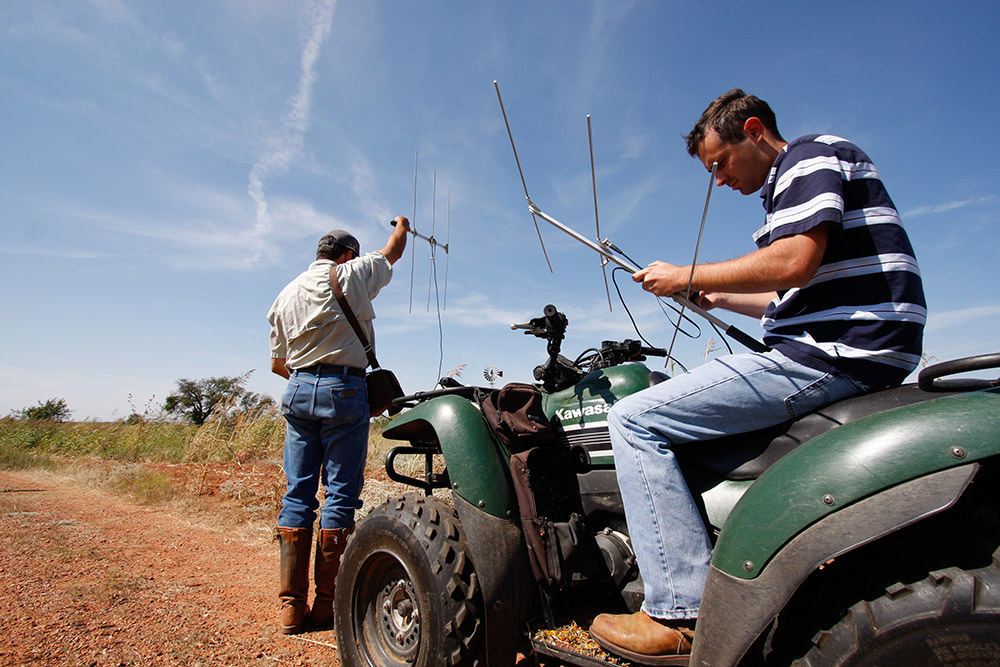
  • VHF Collars from American Wildlife Enterprises: These collars represent a more traditional technology in wildlife telemetry. Costing $200 per unit, they require a technician to physically locate each bird with a handheld receiver and directional antenna. Because of the labor involved, we generally record only one location per bird per day.
     

Cost-Benefit Analysis

Data Collection and Accuracy: The most significant advantage of the GPS collars lies in the volume and accuracy of data. Multiple automated GPS fixes allow us to construct highly detailed movement paths and habitat use profiles for each bird. In contrast, the VHF system yields a single data point per day, offering only a coarse picture of movement unless field teams invest significant additional effort.

Labor and Time Commitment: GPS collars reduce human labor substantially. Once deployed, the collars autonomously collect location data, freeing up staff for other critical tasks. Conversely, VHF tracking demands daily boots-on-the-ground work. Field technicians must search for each bird, often in rugged terrain and under variable weather conditions. This makes the VHF approach more time-intensive and potentially more disruptive to the birds.

Equipment Reliability and Recovery: One important consideration is collar recoverability and long-term data security. GPS collars depend on solar charging to remain operational. If the collar is obscured by dense vegetation or plumage and fails to receive adequate sunlight, it may stop functioning and become difficult to locate. Without a real-time radio signal, retrieving the collar—and the valuable stored location data—becomes a significant challenge. In contrast, VHF collars emit a continuous pulse, making it far easier for technicians to track and recover them, even if the bird has perished or the collar has become detached.

Economic Costs: While GPS collars cost $50 more per unit, their higher data yield and lower labor demands may result in lower long-term costs per data point. For example, one technician can retrieve and download thousands of data points from GPS collars over a few weeks, compared to the slow and steady pace of daily manual VHF tracking.  However, these GPS collars rely on cellular communications to upload the data to a central database.  An added requirement of using these trackers is the use of “HUB’s”.  These are stations that automatically download data from each collar when the quail comes within a 1,600 yard diameter of the HUB.  With each HUB costing roughly $1200, and adding to that a $60 subscription fee for the cellular data usage, the actual cost of the GPS collar quickly exceeds the $250 base price.

Looking Ahead

As this project unfolds, we’ll continue to analyze and compare the real-world performance of these collars under field conditions. Our preliminary impressions suggest that the higher upfront investment in GPS technology may be justified by the quality and quantity of data obtained. However, VHF collars remain a viable and more affordable option for smaller-scale studies or programs with limited funding.
This research underscores RPQRR’s dedication to applying cutting-edge technology in our quest to better understand quail ecology. By refining our methods, we’re not just improving our own research—we’re helping set the standard for quail studies nationwide.

Interested in helping with this project? Then consider making a donation of $250 towards the purchase of a GPS collar, donations can be made at https://www.quailresearch.org/donate/

<!–


–>


Dallas Safari Club Donates $10,000 to RPQRF

Celebrating a lifetime of dedication to quail conservation, Dr. Dale Rollins was recently awarded the 2025 Conservation Trailblazer Award by the Dallas Safari Club. This prestigious recognition includes a $10,000 contribution towards a wildlife conservation organization of his choice. Dr. Rollins, a long-time leader in quail conservation, has designated the Rolling Plains Quail Research Foundation as the recipient of this significant contribution. For nearly two decades, Dr. Rollins has been instrumental in leading the Rolling Plains Quail Research Foundation, championing critical quail research, habitat management and education.  This generous gift will significantly advance the Foundation’s vital programs and research, building upon Dr. Rollins’ legacy. We extend our deepest gratitude to the Dallas Safari Club for their substantial donation and to Dr. Rollins for his unwavering commitment to our mission. The funds will go towards funding a new research project that will analyze the use of GPS and VHF collars on quail monitoring projects. We plan to test GPS collars with the hope of gaining more accurate data, more locations, and their longevity compared to the VHF collars – this is the theory at least.  The funds will be applied directly to supporting this project.   


<!–


–>


Warren CAT Donates Skid Steer to RPQRF

We are thrilled to announce that Warren CAT has generously donated a skid steer to support our efforts to conduct habitat management practices that benefit bobwhite and scaled quail on the Rolling Plains Quail Research Ranch. This piece of equipment will be vital in ongoing and new research projects involving habitat management practices and maintenance of infrastructure on the ranch.

<!–


–>


Open Canopy Management: A Key to Bobwhite Quail Recovery in Texas by Dr. Dan Foley

In Texas, few sounds evoke a stronger connection to the land than the whistled “Bob-white” call of the northern bobwhite. Once abundant across the state’s open rangelands, bobwhite quail populations have declined drastically over the past several decades. One critical factor behind this decline is the loss of open canopy landscapes — a habitat condition essential for quail survival. As we fully transition into Spring, and the mesquite trees replace their green canopy, I’m reminded at just how rare open canopy landscapes have become across much of Texas.
 
Bobwhite quail depend on early successional habitats with a patchwork of native grasses, forbs, and sparse woody cover. Open canopy conditions — generally less than 30% tree cover — are necessary to allow sunlight to reach the ground, promoting the dense herbaceous vegetation that provides food, nesting, and brood-rearing sites. When tree or brush cover becomes too dense, ground vegetation thins, predator visibility increases, and the habitat suitability for quail plummets. In Texas, the major culprits behind this shift are the aggressive spread of mesquite and juniper (commonly called “cedar”) species.
 
The scale of woody plant encroachment in Texas is staggering:

  • Over 25% of Texas’ rangeland — approximately 32 million acres — has been heavily impacted by mesquite invasion.
  • Juniper has expanded across over 8 million acres, particularly in the Edwards Plateau, Cross Timbers, and Hill Country regions.
  • In areas like the Rolling Plains and South Texas, mesquite thickets now dominate landscapes that once supported thriving quail populations.

 This transformation has converted once-open savannas and grasslands into closed-canopy woodlands, significantly diminishing the availability of quality bobwhite habitat. It has been estimated that in some parts of Texas, such as the South Texas Plains, woody cover increased by more than 60% over the past century — a major barrier to sustaining quail.
 
Reversing this trend requires proactive management focused on restoring open-canopy conditions:
1. Brush Management and Tree Thinning—Selective clearing of mesquite and juniper, using mechanical methods (e.g., root plowing, grubbing) or targeted herbicide applications, is crucial. Clearing should aim to create a mosaic of open grasslands interspersed with minimal clumps of brush for protective cover.
2. Prescribed Fire—Fire historically maintained Texas’ prairies and savannas. Today, prescribed burning remains one of the most effective tools to control young mesquite and juniper, stimulate native grasses and forbs, and prevent woody plant re-establishment. Ideally, burns should occur every 2–4 years, depending on rainfall and site conditions.
3. Grazing Management—Proper livestock management can complement habitat restoration efforts. Overgrazing can reduce the native plant community critical to quail, while well-timed, moderate grazing can help maintain the open structure necessary for bobwhite habitat.
4. Reseeding Native Vegetation—In heavily degraded areas, reseeding with native species like little bluestem, sideoats grama, and native forbs may be necessary after brush removal to quickly restore ground cover suitable for quail.
 
Open canopy restoration benefits more than bobwhite quail. Species like scaled quail, Rio Grande turkey, monarch butterflies, Texas Horned Lizards and a suite of grassland songbirds all rely on similar habitats. Additionally, open landscapes help improve soil health, enhance groundwater recharge, and reduce wildfire risk — major concerns in a drought-prone state like Texas.
 
The decline of bobwhite quail in Texas tells a larger story about landscape change. Yet, the tools to turn the tide are in our hands. Through active canopy management — particularly by controlling mesquite and juniper encroachment — we can restore the open, sunlit prairies and savannas that bobwhites, and so many other species, call home. In Texas, where land stewardship is a proud tradition, restoring open habitats offers a powerful way to ensure the next generation can still hear the familiar “bob-white” call across the rolling hills and plains.

<!–


–>


RPQRF Welcomes New Member to the Team

We are excited to introduce our newest member of the RPQRF Team, Kyndal Underwood! She’s actually not new to the research ranch, she has been working as a Research Quail Technician for us since May 2024, but because of her outstanding work ethic, leadership skills and eagerness to conduct wildlife research and habitat management, we decided to offer her a permanent place on the team. She will be our Ranch Biologist, assisting with all quail research activities, conducting habitat management practices, providing leadership, training and guidance to our summer interns and technicians. We are excited to see all the things Kyndal will accomplish at the ranch! She is also an avid hunter and a new owner of her first bird dog, Maisy!

<!–


–>


Reviving CRP for Quail by Mitchell Riggs

The Conservation Reserve Program (CRP) was established by Congress in 1985 as part of the Farm Bill and is administered by the Farm Service Agency (FSA). The program’s goal is to reduce soil erosion by paying farmers to plant perennial vegetation, typically grasses, on former crop fields. Contracts generally last 10 to 15 years, with landowners receiving annual rental payments per acre enrolled.

In the early years, CRP fields were often planted with introduced grasses such as Old World Bluestem, Kleingrass, and Wilman’s lovegrass. These species establish quickly and are effective at reducing erosion, but they provide limited habitat value for native wildlife, particularly grassland birds like quail. Over time, there’s been a shift toward restoring these fields with native grasses and forbs to better support biodiversity.

At the Rolling Plains Quail Research Ranch, we have four CRP fields that have recently expired. One field in particular had consistently lower quail numbers compared to the rest of the ranch. While several factors likely contribute, one clear issue was the dominance of exotic grasses, which lack the structure and diversity needed by quail and other grassland species.

To address this, we consulted with our local Texas Parks & Wildlife Department (TPWD) biologist, who recommended enrolling in the Pastures for Upland Birds (PUB) program. After applying and being approved, we began the restoration process to convert the field back to native rangeland.

On March 25th, we conducted a prescribed burn to remove existing vegetation and prepare the site for herbicide application. The fire didn’t carry as thoroughly as hoped, so we introduced cattle from April 16th to May 10th to graze and trample the remaining biomass. Then, on May 11th, we aerially applied glyphosate herbicide at a rate of 2 quarts per acre, TPWD provided the chemical for this phase. We will monitor the field throughout the summer, and if exotic grasses reemerge, we plan to apply a second herbicide treatment.

In the fall, we’ll reseed the pasture using a diverse native seed mix provided by TPWD. They will also supply a seed drill to ensure proper planting. Our goal is to reestablish a healthy, functioning native grassland that provides high-quality habitat for upland birds, particularly quail.

We’re optimistic that this project will lead to increased bird numbers and serve as a model for converting monoculture CRP fields into thriving native ecosystems. For more information on TPWD’s PUB program contact your local TPWD wildlife biologist or click here.

<!–


–>


Dr. Dale on Quail Podcast: Coyotes and Quails

Join Dr. Dale and his special guest Dr. John Tomecek as they delve into recent research on coyotes. Are coyotes a rangeland icon or pariah? How big a threat are they to quail, the answer may just surprise you. 

For previous sessions, see www.quailresearch.org/resources.  Thanks to Gary Joiner at Texas Farm Bureau, Jonathan Vail (Texas Parks & Wildlife Foundation) for his technical expertise, Jeffrey Sorelle with RPQRF for logistical assistance, and Gordy & Sons of Houston for funding. If you have a suggestion for an interesting interviewee, please e-mail Dr. Rollins ([email protected]).

<!–


–>


From Our Facebook Page by Dana Wright

The Facebook post of the month goes to a post featuring a video submitted by a QuailMaster graduate, Jesse Woods of Midland. The video was of a pair of blue quail with 19 chicks running around. There is absolutely nothing cuter than a day-old quail chick! We have not documented a hatch at the Rolling Plains Quail Research Ranch this spring yet, but our technicians are monitoring numerous hens sitting on nests. Conditions around the Rolling Plains have been very favorable for quail this spring going into summer!

<!–


–>


Statewide Quail Symposium Planning Underway!

Registration will open up later this month for the Statewide Quail Symposium which will be held in Abilene, Texas at the Abilene Convention Center September 17-19, 2025. The first day of the symposium, September 17, will be a tour of the Rio 42 Ranch near Lueders, TX. This year, we will have charter buses providing  roundtrip transportation from the Abilene Convention Center/DoubleTree Hotel to the ranch for the tour. This incredible ranch has used many tools to create and maintain bobwhite quail habitat, it’s worth the drive. The DoubleTree Hotel next to the convention center will be the host hotel for the event, we are excited to partner with them since they are within walking distance to the convention center. Stay tuned for more information on the room block!

<!–


–>


Support Quail Research!

The Rolling Plains Quail Research Foundation greatly depends on annual donations. We hope you will consider making a contribution. You can make your donation online at our website here, or mail your check payable to Rolling Plains Quail Research Foundation.
 
Rolling Plains Quail Research Foundation
PO Box 220
Roby, TX 79543

<!–


–>


Got e-Quail?

Got a new e-mail address? Please [Click Here] to update your information if you wish to continue receiving e-Quail.

Forwarded from a friend?  Please [Click Here] to sign up for the RPQRR e-Quail Newsletters!

<!–


–>


Website

Facebook

YouTube


Copyright © 2025 Rolling Plains Quail Research Foundation, All rights reserved.

Our mailing address is:
Rolling Plains Quail Research Ranch
1262 US Highway 180
Rotan, TX. 79546

Want to change how you receive these emails?
You can update your preferences or unsubscribe from this list.