by Dan Foley
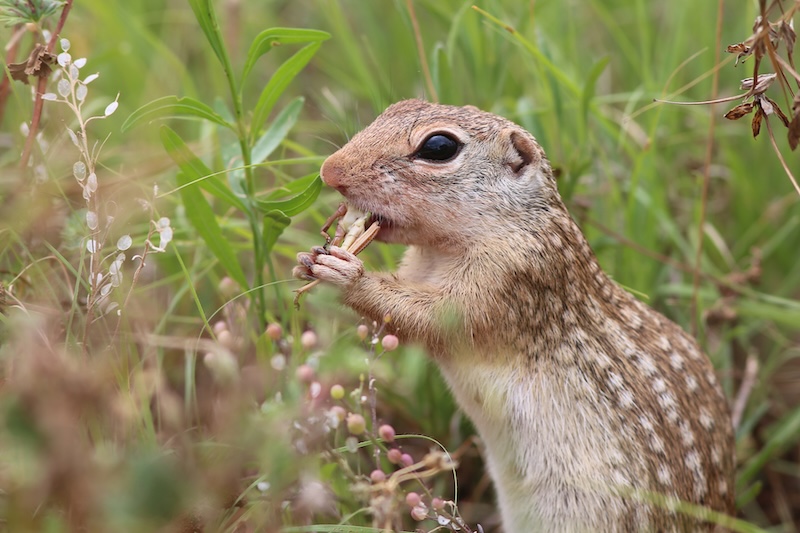
The Mexican ground squirrel is easy to overlook. It looks like a small, striped, harmless seed-eating rodent often seen in short grass, roadsides, grazed pastures, and field edges. But its diet tells a more complicated story. Scientifically, the species is best described as an opportunistic omnivore. It eats plants, seeds, insects, and, when available, animal matter.
Across its range, the ground squirrel consumes green vegetation, seeds, grains, fruits, insects, other arthropods, carrion, eggs, and occasional small vertebrates. Texas accounts describe a seasonal pattern. Early in spring, green grasses and forbs are important. Later in the growing season, seeds and flower heads become more common, but insects also become a major food source. Some stomach-content reports indicate that insects may make up more than half of the material consumed.
These squirrels are not simply herbivores that occasionally swallow a grasshopper. They actively eat grasshoppers, crickets, caterpillars, beetles, ants, and insect eggs. In some studies, animal matter has approached half of the diet by volume, with most of that animal material consisting of arthropods. In practical terms, ground squirrels can be as much insect predators as seed consumers during parts of the year.
The question for quail managers is whether this makes them meaningful predators of northern bobwhite or scaled quail nests. The answer is: possibly, but probably not primary predators. Ground squirrels are capable of eating eggs. Bird eggs are listed among their foods, and Texas descriptions note that they have eaten mice and have even been reported capturing small birds. Those observations show behavioral flexibility. A quail egg in an unattended nest would not be beyond their ability.
Still, capability is not the same as importance. Most evidence indicates that insects and plant material make up the bulk of their diet, not vertebrate prey. Reports of eggs, chicks, or mice should be treated as opportunistic events unless supported by local nest-camera data, stomach contents, scat DNA, or other direct evidence. In the Rolling Plains, quail nest loss comes from a broad predator community, including snakes, raccoons, skunks, coyotes, raptors, rodents, and even invertebrates. It would be a mistake to elevate ground squirrels to “major quail predator” status simply because they are omnivorous.
But it would also be a mistake to ignore them. Their habitat overlaps with quail in open grasslands, grazed pastures, disturbed areas, and edges with short vegetation. They are diurnal, ground-active, and small enough to move through nesting cover with little obvious disturbance. A nest camera that records a squirrel consuming an egg may not reveal a dominant predator, but it may document a real, low-frequency source of nest loss.
This is where predator ecology becomes more interesting than the usual “good predator” versus “bad predator” discussion. Coyotes, for example, are often viewed negatively in gamebird management. Yet data consistently indicate coyotes generally do not specialize on quail. Quail are usually a minor and opportunistic food item. Coyotes may affect quail more strongly through indirect pathways, especially by preying on small mammals, including ground squirrels where they are available.
In other words, a predator that rarely targets quail directly may still benefit quail indirectly by suppressing smaller animals that occasionally depredate nests. This does not mean coyotes are always beneficial, nor does it mean ground squirrels are major villains. It means quail exist within a food web, not a simple predator list. Removing or reducing one predator can release another, and the net effect on quail may depend on what each predator eats most often.
The best working hypothesis is that ground squirrels are occasional quail nest predators, not quail specialists. Their impact likely varies with season, squirrel abundance, insect availability, vegetation structure, and nest exposure. Larger predators such as coyotes may, in some settings, help quail more by preying on these occasional nest predators than they harm quail through direct predation.