By: Dr. Dan Foley
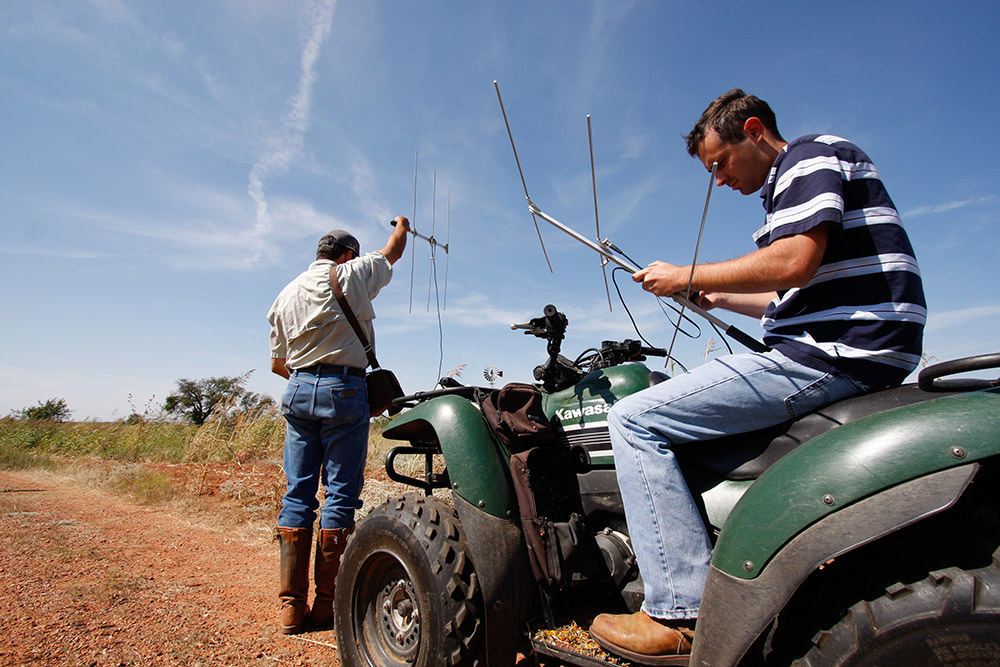
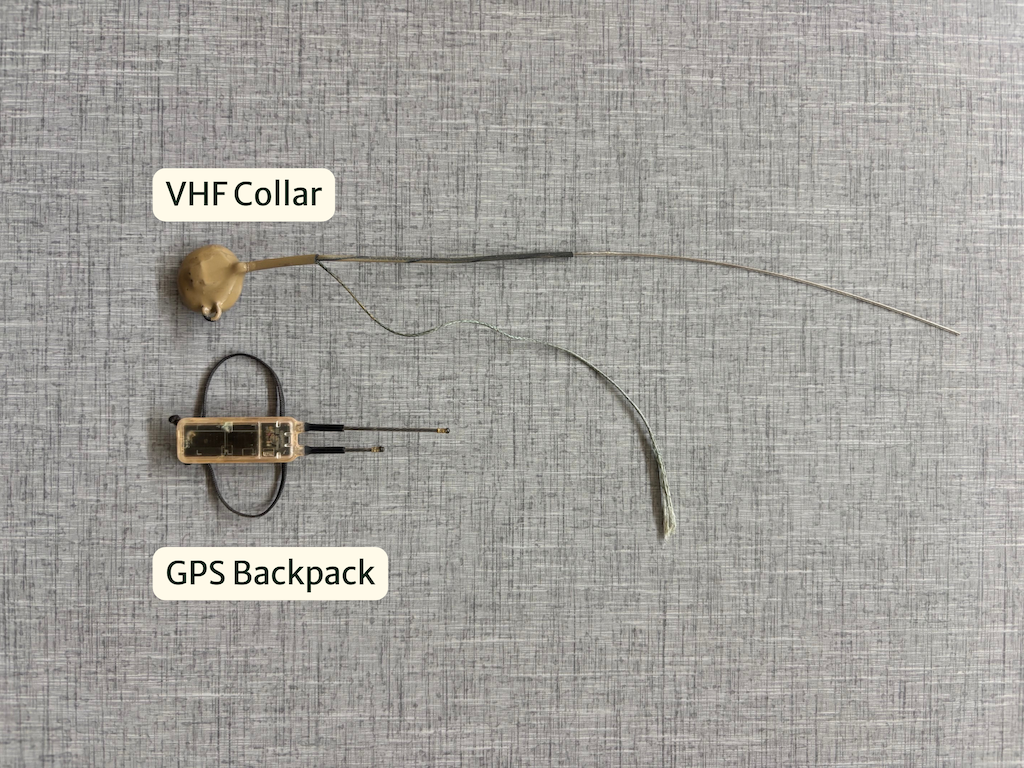
For decades, traditional VHF radio telemetry has been one of the most important tools in quail research.
VHF collars allowed researchers to relocate bobwhites, estimate survival, identify general habitat use, and find nests that otherwise would have gone undetected.
That technology built much of the foundation for what we know about bobwhite ecology. But as tracking technology advances, GPS collars are opening a new window into the lives of wild quail—especially during nesting.
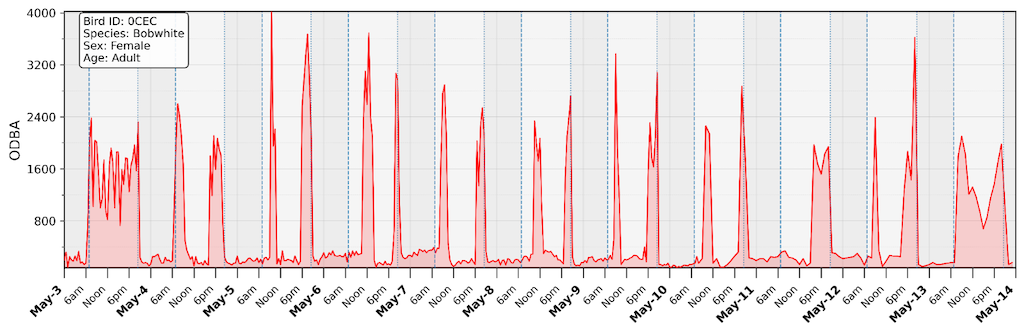
The graph shown here comes from a solar-powered GPS tracking collar equipped with an accelerometer on an adult female bobwhite. The accelerometer records fine-scale body movement, summarized here as ODBA, or Overall Dynamic Body Acceleration. In simple terms, higher ODBA values indicate more intense movement, while low values indicate relative stillness. This single trace tells a remarkably detailed story.
On May 3–4, the bird was in a pre-incubation period. Movement was frequent and irregular as she continued normal activity before settling into full incubation. Beginning around May 5, the pattern changed sharply. For the next nine days, the female exhibited the classic signature of incubation: long periods of very low movement while sitting on the nest, interrupted by short bursts of activity when she left the nest or responded to disturbance. Around May 13–14, that incubation pattern ended abruptly. The nest was depredated after approximately nine days of incubation.
For bobwhite, full incubation is approximately 23 days. That biological benchmark is important. If this low-activity incubation pattern persists for roughly 23 consecutive days, it provides strong evidence that the bird remained on the nest through the full incubation period and that the nest had a high likelihood of success. In this example, however, the pattern broke after only nine days, indicating failure well before expected hatch. The collar captured not just that the nest failed, but when incubation began, how long it lasted, and when the behavioral pattern ended.
That level of detail over time is difficult and often impossible to obtain with traditional VHF methods. With VHF telemetry, researchers typically locate birds by triangulation, similar to a game of “hot and cold” trying to figure out the exact location of a nesting bird. To monitor a nest closely, technicians often must physically approach the area, sometimes repeatedly. Even when done carefully, repeated nest checks can create disturbance, leave scent trails, or alter predator activity near the nest site. VHF provides only periodic snapshots, making it difficult to pinpoint the onset of incubation, nest abandonment, or depredation.
GPS collars reduce that uncertainty. They allow researchers to monitor movement patterns remotely, often without repeatedly entering the nesting area. When GPS locations are paired with accelerometer data, researchers can distinguish broad behavioral states such as pre-incubation movement, sustained incubation, nest recesses, and post-failure movement. The nest can be watched more continuously while the bird and nest site are disturbed less.
There are still practical considerations when deploying GPS collars. The units used in this work are solar powered, so they are best suited for habitats with enough sunlight to maintain charging and consistent data collection. Dense canopy, heavy brush, or prolonged shading can reduce solar performance and may limit how well the collars function in some study areas. As with any field technology, deployment decisions still need to match habitat structure, study objectives, and animal welfare considerations.
Importantly, several of the old tradeoffs between GPS and VHF technology are no longer major barriers. Cost differences have narrowed substantially, and collar weight is no longer necessarily a limiting factor for GPS deployment. In some applications, GPS collars can now provide finer-scale movement and behavioral data without imposing a greater weight burden than traditional VHF collars. VHF telemetry remains useful in some study designs, but for nesting studies, GPS and accelerometer collars provide a clear advantage: they turn nest monitoring from a series of field visits into a continuous behavioral record.

For bobwhite research, that matters. Nest survival, incubation behavior, recess frequency, predator timing, and female response after nest failure are all central to understanding population dynamics. GPS technology allows us to measure those processes more precisely and with less intrusion. In this case, one collar documented the transition from pre-incubation behavior, through nine days of incubation, to nest depredation—all without needing to repeatedly disturb the nest.
That is the future of quail telemetry: better data, finer timing, and a lighter footprint on the birds we study.